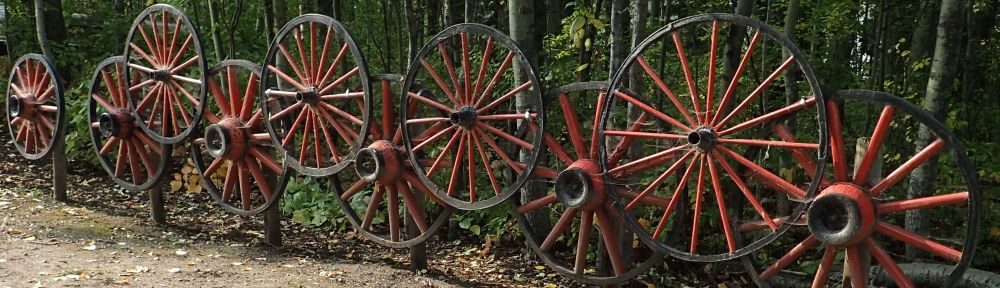
St. Albert’s history reflects a unique blend of geological and cultural influences. From ancient ice sheets shaping the land to European settlement and the rise of trading posts, the area evolved significantly. Once a vibrant community with rich resources for First Nations, it has transformed into a rapidly growing suburb, risking its fertile farmland to urbanization.

Canada differs from the United States in the direction of European contact. For the US, contact was a relentless push west from the Atlantic to the Pacific. The same is true of Canada – but only after the railroads. Before that, the push was from the North to the South via trading posts.
- EASY-PEASY
- Worth Visiting
- Washrooms.
- Kid Focused
A Cross Section of Western Canadian History
St. Albert was distant enough from Hudson Bay and Montreal to mean that when trading companies arrived, they already were well oiled trading-machines. However, long before the first Voyageur canoe showed up on the Sturgeon River, this area had already been changed through ancient seas, and climate. In this respect, St. Albert is a unique cross section of Western Canadian History. It is a story of people in transit, settling, being displaced, and settling again [1].
The Big Ice Cube
The modern (in geological terms) St. Albert story starts with the mothers of all ice cubes, the Cordilleran and Laurentide ice sheets. At the height of ice age, these two sheets touched and then began to retreat, Cordilleran back into the Rocky Mountains and the Laurentide up towards Baffin Island. The nature of this retreat is important because in between these two sheets was an ice-free corridor. According to the Clovis Theory, at least a portion of the first humans (and other critters) came through this corridor [2].

The retreating glaciers left behind a rich mix of silt and clay which would create exceptional farmland and something we will return to in a few thousand years – but first, the thick forest.
Mixed Forest
In Southern Alberta is the Prairie, in the Northern Alberta the Boreal Forest and in between is the Aspen Parkland. The North Saskatchewan River valley is roughly a transition between these last two. Bison and other herbivores used this transition zone to feed and live. Where there are Bison, the First Nations would soon follow.
This mixed forest provided greater resources for the Cree peoples who lived here versus the semi-arid prairie to the South, home to the Blackfoot. Without a handy embankment to drive the bison off similar to Head Smashed in Buffalo Jump, this diversity of game was critical. Now let’s fast forward to the 18th century and the trading companies are pushing south.

Trading Posts and the Push South
Edmonton was strategically located between the Blackfoot and Cree First Nations. One of the intentions was to cut out the Cree who acted as the middlemen [3] for this trade.
While Fort Edmonton was relatively long lived, other trading posts winked in and out of existence much faster. Fort Saskatchewan, at the confluence of the Sturgeon and North Saskatchewan, still bears the HBC name. St. Albert briefly had a trading post; it was located about where the grain elevators now stand, but lasted only a few years.
Let’s Move Here!
As Europeans settled in the area, they ‘took’ native wives and became the Metis. Many of them French, they initially settled in and around Lac St. Anne, about 50 KM to the west. The problem with this area is that it lost the glacier lottery.
While St. Albert and the Edmonton area was blessed with clay and silt, moraines and rocks better describe the area around Lac St. Anne. While visiting his small flock on the Sturgeon River with Father Lacombe, Bishop Tache noted the much richer soil. He declared a new community to be established in in the area the Cree knew as Mista-sakahikun. [4]
French and Catholic Influence
As Alberta’s oldest non-fortified community, the area had a different start from most communities. Preceding Canadian confederation by six years, it had a strong French and Catholic flavour.
For many years, St. Albert was the center of Catholic activity not only in the area but in a large area including what is now the provinces of Alberta, Saskatchewan and the Northwest Territories. In 1871, Rev. Vital Grandin was appointed the first Bishop of the newly created See of St. Albert. The Bishop, his nine Oblate priests and a few brothers ministered to about 12,000 aboriginal peoples, 5,000 Métis and a few hundred European Immigrants [5].
Training the Focus on Edmonton and Strathcona
While St. Albert was on the main travel routes to the rich trapping areas, the coming of the railway changed that. The train arrived in Strathcona in 1891, via the Calgary and Edmonton Railway (the CPR arrived in Calgary a decade earlier) [6]. This accelerated a move away from St. Albert to Edmonton. Add on the fact that the North Saskatchewan River provided better access and the result is that St. Albert became a sleepy farming community with a population less than 1,000 souls until the early 1950’s [6].
Growth is a Mixed Blessing
In the late 1950’s city council actively promoted St. Albert as a bedroom community for Edmonton. Fast forward fifty years and its population increased fifty-fold from 1,100 to 53,000.
While I appreciate this growth as it means I have a nice home to live in, the reality is that St. Alberta (and metro-Edmonton) is sitting on some of the best farmland in Alberta – which is being slowly (or not so slowly) lost to urban expansion. While pondering this fate, let’s take a 10km walk through St. Albert and grab a coffee en route.
St. Albert Walking Tour Details
Any maps and map views are for general information only. Do not rely on them for navigation or to determine legal boundaries.
1. Starting at the South Side of St. Albert Place (5 St Anne St, St. Albert, AB T8N 3Z9).
- Cross St. Anne Street and walk across the parking lot to Founders Court.
- The Big Ice Cube can be referenced either in front of the St. Albert Place or inside if weather is cooler.
- As of writing, St. Albert Place is open from 7am every day except statutory holidays. Water and washrooms are available inside.
2. Founders Court, west of Perron Street.
- The buildings of Founders Court a good discussion point for the ice-free corridor.
- A statue of St. Albert used to stand in this courtyard but was stolen in March 2023.
3. Cross to the East Side of Perron Street.
- Butt Hinge is both functional and whimsical and was created by Garry Jones in 1996.
- In 1997, it may have saved the lives of pedestrians as a motorist collapsed at the wheel and the massive sculpture stopped the vehicle.
- Location: 15 Perron Street, Courtyard
- Read More: Butt Hinge (1996).
4. Cross Perron Street: Butt Hinge.
- Butt Hinge is both functional and whimsical and was created by Garry Jones in 1996.
- In 1997, it may have saved the lives of pedestrians as a motorist collapsed at the wheel and the massive sculpture stopped the vehicle.
- Location: 15 Perron Street, Courtyard
5. Head south (left) along Perron Street
- Head south (left) along Perron Street towards the Clock Tower.
6. Clock Tower
- At the Clock Tower, note the calibration plaques and an information board for the Buffalo Hunt.
- The Clock Tower was built in 1995 as an engineering research project on how newly fired bricks cool.
- It was built with volunteer labour and has played a part in at least two research projects.
- A leaning tower was originally proposed.
- Read More: Perron Street Clock Tower | T8N.
7. Buffalo Hunt Statue.
- Cross the Sir Winston Churchill to the Southeast park and Buffalo Hunt Statue.
- Read More: New statue looks over downtown and historic past.
- Created by Don and Shirley Begg of Cochrane in 2011, the statue weights 800 lbs.
- This spot is a good location to discuss Mixed Forrest.
8. Time is a River
- Time is a River was developed as a lasting monument to pay tribute to the civic involvement.
- The project was installed in July 2011, and consists of five carved basalt standing stones.
- Location: 55 Sir Winston Churchill Avenue.
9. St. Thomas Street Artwork
- Created by Karen Ho Fatt, Blooms Bench (2001) is both a bench as well as an aesthetically pleasing taste of nature situated right in the heart of St. Albert’s Perron district.
- Wenden Way (1995), created by Ken Macklin, it is meant to explore the organic forms found in nature.
- Threshold (1999) represents a fifteen-foot-tall peregrine falcon with one missing wing symbolizes the persistence of a species: created by Robert Spaith.
10. Cross St. Anne Street
- Note the Court House to the left and the Arden Theatre to the right.
- In front of the St. Albert Place is the sculpture Hide & Seek (1994).
11. Walk Through St. Albert Place.
- Note the Stain Glass Windows above the North doors.
12. Art Work Behind (North) of St. Place.
- Directly behind St. Albert Place are a series of statues with a First Nations theme: Mother Earth Circling Buffalo (2006), Mother Bear Prays for Earth Healing (2007), and Buffalo Mountain (2010).
13. Children’s Bridge.
- Turn Left along the Red Willow Trail and Proceed to the Children’s Bridge.
- A grieving father originally asked that the bridge be named for his deceased daughter, killed by a drunk driver.
- Instead, it was named for all Children and in honour of the UN Year of the Child.
14. Healing Garden / Kâkesimokamik and ACT/UCT Celebration Gardens.
- Turn Right and pass the Healing Garden / Kâkesimokamik
- Continue and pass the ACT/UCT Celebration Garden.
15. Chapel of the Immaculate Conception and the Little White School.
- Turn Left before Perron Street.
- Pass by the Chapel of the Immaculate Conception
- Continue up the pathway towards the Little White School.
16. St. Albert Parish / Catholic Church.
- At the top of the escarpment, cross St. Vital Street.
- Head towards the St. Albert Parish / Catholic Church.
17. Mary’s Grotto and the St. Albert Roman Catholic Cemetery.
- Walk behind the church is Mary’s Grotto and the St. Albert Roman Catholic Cemetery.
18. McKenney Avenue, descend the hill.
- Continue North to McKenney Avenue and turn right to descend the hill.
19. Visit Michif Cultural Connections house
- Turn Right at Muir Drive, working your way through community of Mission.
- Visit Michif Cultural Connections house at the corner of Mission and Madonna.
20. Pass under St. Albert Road bridge.
- Continue East along Mission Avenue connecting to the Red Willow Trail System, pass under St. Albert Road bridge.
21. West along Boudreau Road.
- Continue on the Red Willow Trail System, heading East (down river) until reaching Boudreau Road.
- Go under the bridge and then turn Left to walk West along Boudreau Road.
22. Shops at Boudreau.
At Bellerose Drive, visit one of the businesses at the Shops at Boudreau.
23. Walk along the Sturgeon River via the Red Willow Trail System.
- After a cup of coffee and a treat, cross Boudreau Road and proceed South (away from Bellerose).
- Cross the Sturgeon River and exit and join the Red Willow Trail System.
24. Benoit Bridge and the 1888 NWMP Building.
- Proceed South/West along the trails (walking upstream). Along the Trail note the Benoit Bridge and the 1888 NWMP Building.
25. Pass the St Albert Cenotaph on St. Anne. Street.
- Cross Under the Perron Street Bridge and then Walk along Perron Street, turning Right at St. Anne Street noting the St Albert Cenotaph en route.
26. Finish the Walk in Front of St. Albert Place.
- Hopefully you enjoyed your walk and learned a wee bit, be sure to leave a comment or like!
Area Details
- Name/Owner: Municipal Trails and Art Work.
- Is it Worth It and Why Go Here?: Overall (5 out of 5) An extensive trail system runs along the Sturgeon River in St. Albert. This is both a trip through Alberta’s oldest non-fortified town and public art.
- Wayne Gretzky Units: 13 KM
- Trail Classification: Rating: 100; Access: Granted; Develop: Fully Developed. ; Maint: Maintained; Season: All Season: All trails are cleared by the city. Bridges can ice up however..
- The Drive Out: Not much of a drive although St. Albert Trail partially follows the historic track from Fort Edmonton to St. Albert.
- The Other Shoe: This is a multi-use trail system.
- Frank’s Trip Notes
- Done too many times to count.
- This trip was in support of the Waskahegan Trail Association.
(On smart phones, swipe to advance the pictures)

Looking Southwest at the intersection of Perron and St. Anne, the former location of Bruin Inn, St. Albert Hx Tour, 2025-03-25, P. Potter. 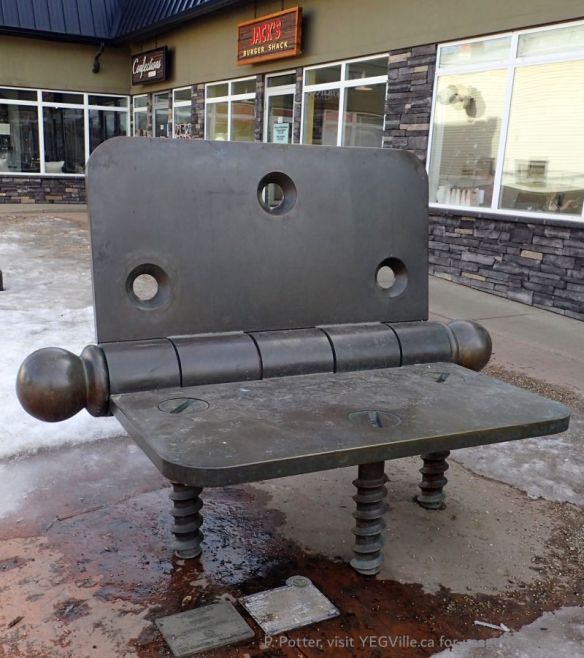
Butt Hinge Art Work in Front of Jack’s Burgers, looking North from Perron St., St. Albert Hx Tour, 2025-03-25, P. Potter. 
Art work, the Buffalo Hunt, looking NE, St. Albert Hx Tour, 2025-03-25, P. Potter. 
Time is a River Art Work, looking South from Perron St., St. Albert Hx Tour, 2025-03-25, P. Potter. 
Blooms Bench Art Work, looking South from St. Thomas toward la Crema Caffe, St. Albert Hx Tour, 2025-03-25, P. Potter. 
Wenden Way (1995), Ken Mackin, looking approximately South from St. Thomas, St. Albert Hx Tour, 2025-03-25, P. Potter. 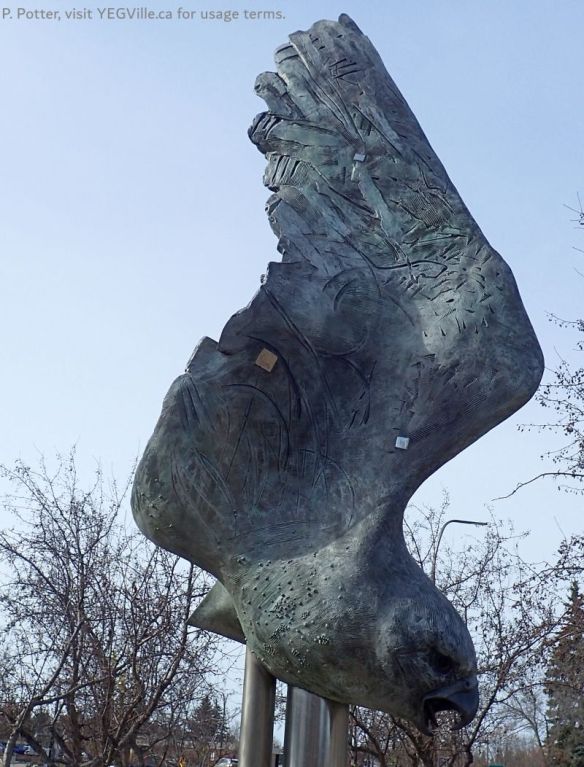
Threshold (1999) art work, Robert Spaith, St. Albert Hx Tour, 2025-03-25, P. Potter. 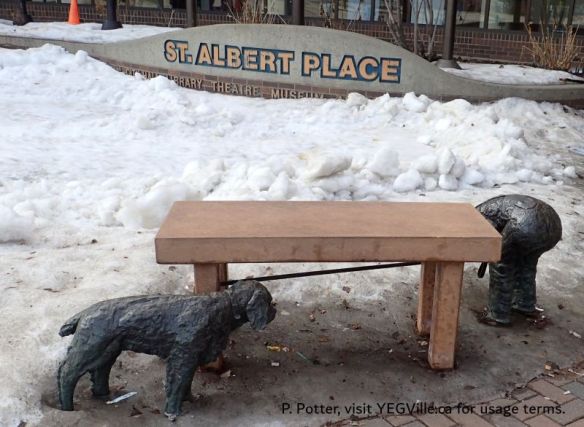
Hide and Seek (1994), Barbara Paterson, in front of St. Albert Place, St. Albert Hx Tour, 2025-03-25, P. Potter. 
Looking West towards the Train Trestle and Big Lake, St. Albert Hx Tour, 2025-03-25, P. Potter. 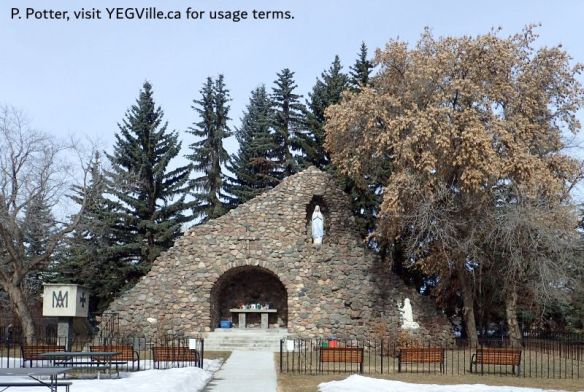
The Grotto behind St. Albert Parish Church, St. Albert Hx Tour, 2025-03-25, P. Potter. 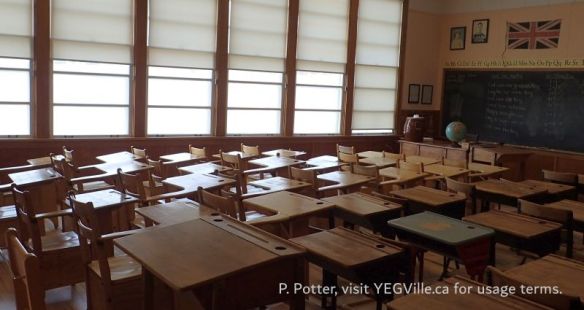
Interior of the Little While School House, St. Albert Hx Tour, 2025-03-25, P. Potter. 
100+ year old graves in the St. Albert Cemetery, St. Albert Hx Tour, 2025-03-25, P. Potter. 
Butterfly Kaleidoscope (2017), Karen Ho Fat Lee, looking roughly west towards the grain elevators, St. Albert Hx Tour, 2025-03-25, P. Potter. 
Looking West along the CN Rail line towards the Grain Elevators and former station, St. Albert Hx Tour, 2025-03-25, P. Potter.
Notes and Reference
- As this is meant to be an overview, I am not going to dwell on European contact with the peoples they found in the Americas. Nevertheless, insert here perspectives of what happens when a stone aged culture encounters a more advanced one. It is important to remember that while your technology may be stone based, you are still human, and all humans have advanced culture adapted for the environment.
- How, when, and where humans colonized the Americas is a subject that is best left to time travelers or archaeologists (who are a type of time travelers). Humans are an invasive species who use their big brains to exploit whatever environment they stumble across. Some possible theories of how we migrated can be found in this article: https://en.wikipedia.org/wiki/Alternatives_to_the_Clovis_First_theory.
- Cultural Landscapes: Aspen Parkland.
- St. Albert celebrates its roots | St. Albert Gazette.
- St. Albert Roots | Catholic Archdiocese of Edmonton.
- St. Albert, Alberta: Demographics | Wikipedia
- Alberta’s best farmland lost to urban expansion, U of A study finds | CBC
Usage: This site is intended for my personal use only and very select invited guests. My recommendation is for you to stay in bed with the covers pulled firmly over your head.
 YEG Ville