
Imabari, a significant city in Japan, has a rich maritime and industrial heritage. Once flourishing as a shipbuilding and textile hub, its economy now faces challenges due to structural changes and competition. The castle, a historic landmark, contrasts with the presence of big box stores, detracting from the city’s charm as a cycling route destination.
AI was used in the research of the factual content used below with subsequent editing.
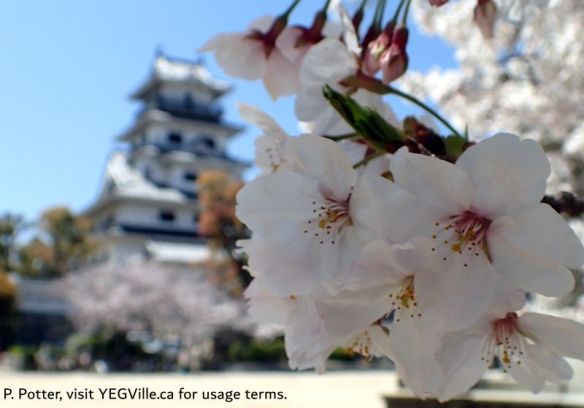
Imabari is either the start or the end of the 70 KM Shimanami Kaido cycling route. Given this central position in the tourist industry you would think it would be a bit nicer. The dotting of the newly built areas with big box stores and malls have not helped with its apparent economic slide.
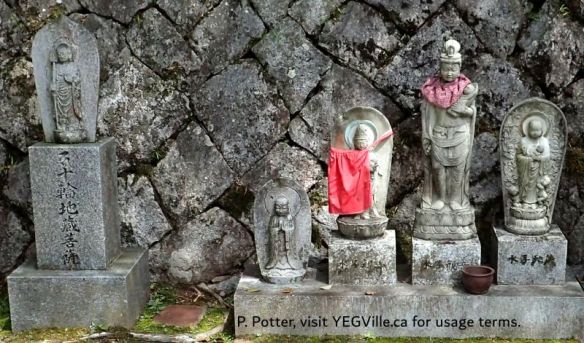
A Sea and Strategic Legacy
The city’s story is shaped by the sea, strategic geography, and a blend of maritime and industrial heritage. Imabari was founded as a castle town on the Takanawa Peninsula, facing the Kurushima Strait. Its coastal position made it the first port in Shikoku opened to foreign trade, anchoring its early economic and political importance.
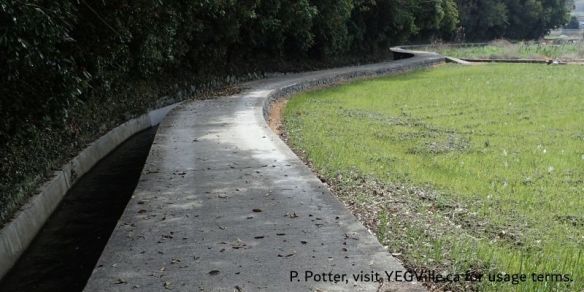
A cement path and water causeway snaking around the base of the hill Eifuku‑ji (栄福寺), Temple #57 is located on, 2026-04-05, Imabari Castle, P. Potter. 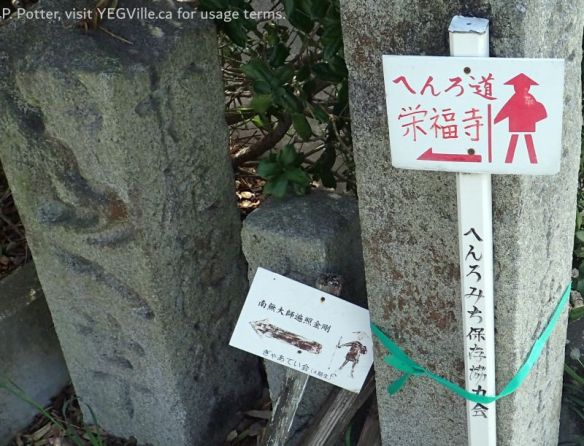
This is a Shikoku Pilgrimage (四国遍路 / Shikoku Henro) route marker pointing the way to Eifuku‑ji (栄福寺), Temple #57 on the 88‑temple pilgrimage; the smaller board is a local cemetery or community notice to direct visitors to nearby memorial sites, 2026-04-05, Imabari Castle, P. Potter. 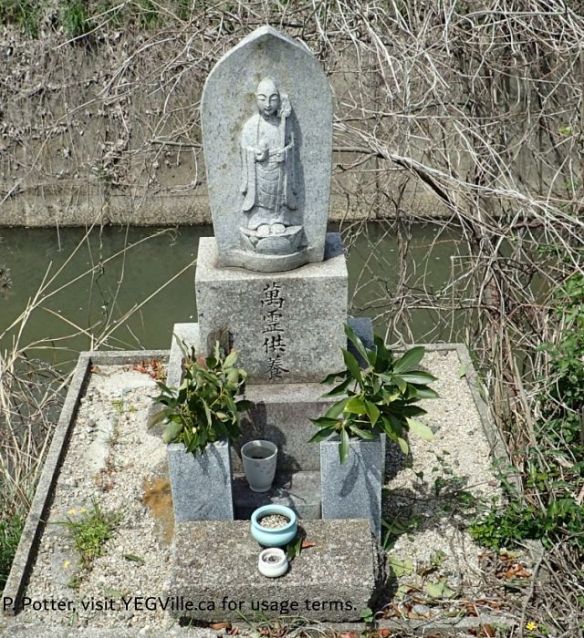
Likely a Jizō shrine (地蔵堂 / お地蔵さん), placed here for travelers and next to a canal, 2026-04-05, Imabari Castle, P. Potter.
Lots of (Ship Building) Cranes – Not the Flying Kind
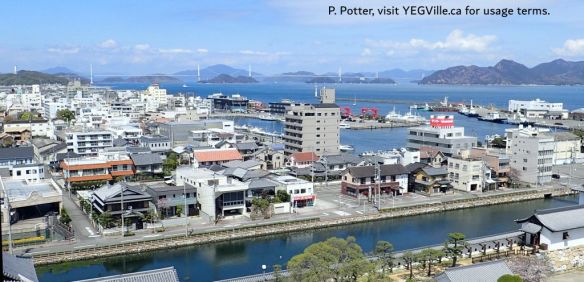
The city’s location on the Seto Inland Sea placed it along major shipping routes. It became known for shipbuilding and maritime commerce. In the early 18th century, Imabari developed a thriving cotton textile industry, eventually becoming famous for its high‑quality Imabari towels, now a nationally recognized brand.
Imabari’s current economic profile is strong but highly concentrated, with shipbuilding as the dominant engine and textiles, logistics, and tourism playing supporting roles. The city is experiencing major structural change driven by national industrial policy and global competition.
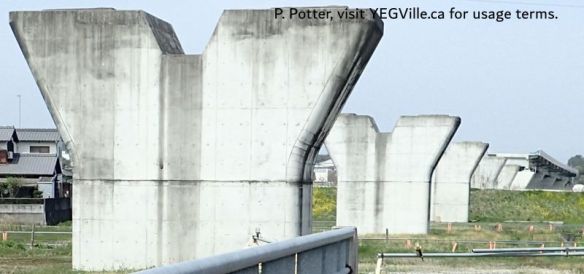
Bridge piers for an unfinished highway started but never completed in the late 1990’s, 2026-04-05, Imabari Castle, P. Potter. 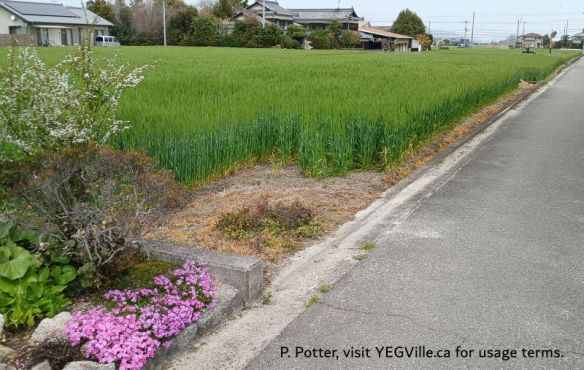
A quintessential image from urban Japan, newish homes, a tidy flower garden, and wheat still being grown in a small lot, 2026-04-05, Imabari Castle, P. Potter. 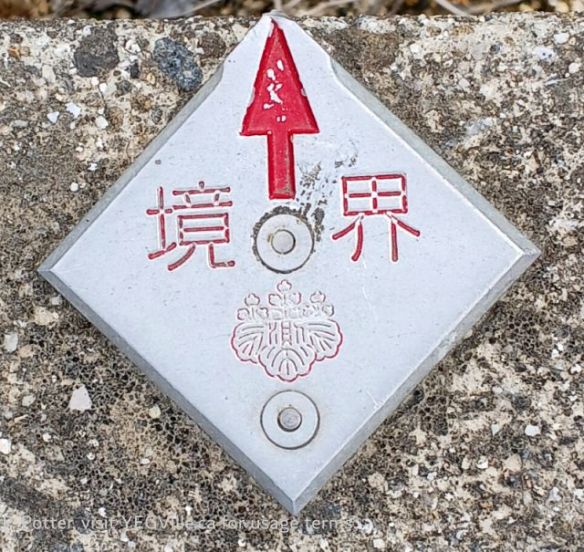
A 界標 (kaihyō) which is an official land‑boundary marker installed as part of land titles, utilities, etc., 2026-04-05, Imabari Castle, P. Potter.
Missing, a Quaint Central Core
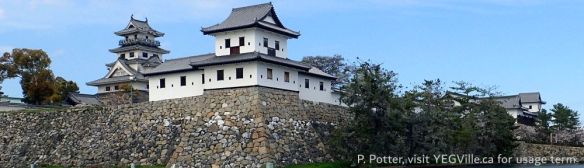
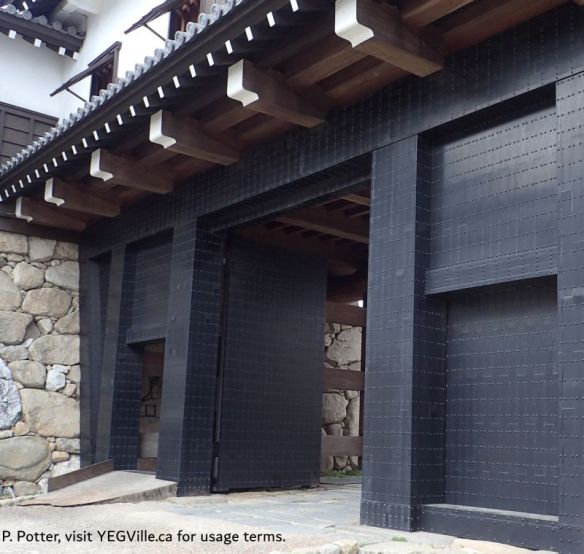
The area has a number of shrines and cemeteries dotted throughout its municipal footprint. The castle at the center is a reconstruction of one demolished in the 1870’s. Prior to this, it was a stronghold for a local feudal clan who used it to control the waterways and collect taxes.
It appears that attempts were made to create a walking area near to castle. Unfortunately, the big box stores have siphoned off shoppers and many of the shops are shuttered. Too bad, Imabari should be the jewel to start or stop the otherwise breath taking Shimanami Kaido cycling route.
 YEG Ville