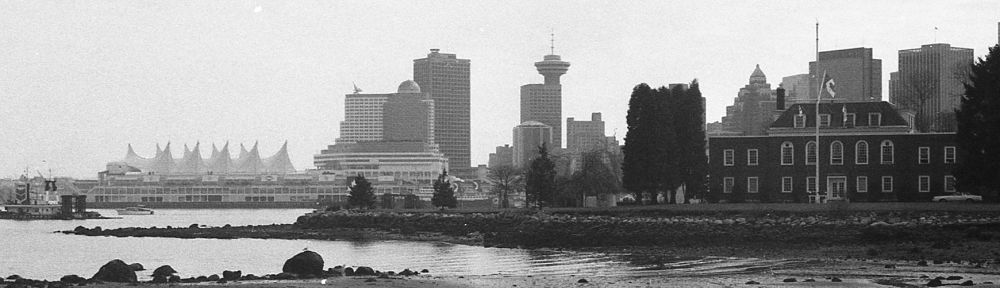
Matsuyama, a lesser-known Japanese city, is rich in history and charm, offering a walkable experience with attractions like Matsuyama Castle and Dōgo Onsen. Despite suffering extensive destruction during WWII, it has preserved its cultural and natural beauty. The city’s mild climate and relaxed lifestyle make it an appealing destination for visitors.
AI was used in the research of the factual content used below with subsequent editing.
- Matsuy – Who?
- 90% Destroyed by 1945
- Matsuyama’s Deeper History
- A Walkable City
- You’re Having a Bad Day When…
The nature of my visit to Japan necessitates that I am only seeing a very small corner of this big/small country. Matsuyama is the first city that would nudge me into wanting to make a return visit. Don’t get me wrong, the rest have been very cool but Matsuyama that much more worthy of a visit.
Matsuy – Who?
Unlike its more famous neighbours of Osaka, Hiroshima, and Kyoto, I had never heard of the city. Not too surprising given that it is a provincial capital with a population around 500,000. This numbered has plateaued in recent years and the city has seen slight annual declines. This decline may be due to the city, like most of Japan, becoming increasingly elderly. Unemployment is relatively low and the population well educated.
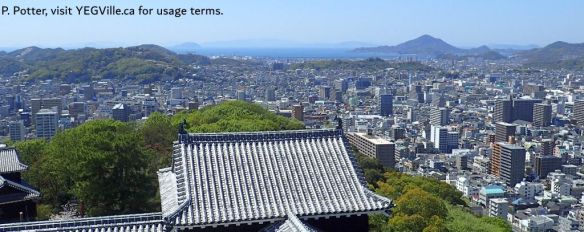
Matsuyama is known for its relaxed pace, historic charm, and coastal scenery. It sits between the Seto Inland Sea and surrounding mountains, giving it a mild climate and easy access to nature. At its center stands Matsuyama Castle, one of Japan’s few remaining original castles, while nearby Dōgo Onsen—often considered Japan’s oldest hot spring—anchors the city’s long bathing tradition. Matsuyama is also known for its literary heritage.
90% Destroyed by 1945
Like other Japanese cities, Matsuyama seems as if it has always existed. The castle dominates the landscape, and the suburban areas sprawl out from this center. Rewind 80+ years and 90% of the urban area was destroyed in repeated air raids during World War Two.
Matsuyama was bombed repeatedly by U.S. forces during the final months of the war.
American bombers struck the city and its military facilities at least 16 times between March and August 1945. Then on July 26, 1945, incendiary bombing caused catastrophic fires across the city. 90% of the city burned and 14,300 homes were destroyed. It’s a quieter story than Tokyo or Hiroshima, but deeply human and locally significant.
Matsuyama’s Deeper History
The city’s deeper history is also rooted in war and destruction. It was created as a castle town (jōkamachi) during Japan’s feudal era. The city began to take shape in the early 1600s. The settlement grew around this stronghold, becoming the administrative center of the Matsuyama Domain.
Long before the castle era, the area was already known for Dōgo Onsen, one of Japan’s oldest hot springs, mentioned in ancient texts. This made the region a destination for travelers and even members of the Imperial family, giving Matsuyama an early cultural and economic identity centered on hospitality and wellness.
Matsuyama was officially established as a city in 1889, growing as a port and commercial hub while preserving its historical landmarks.
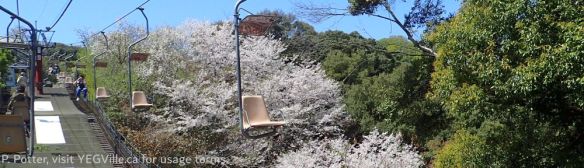
Chair lift up to the castle, 2026-04-08, Matsuyama Castle, P. Potter. 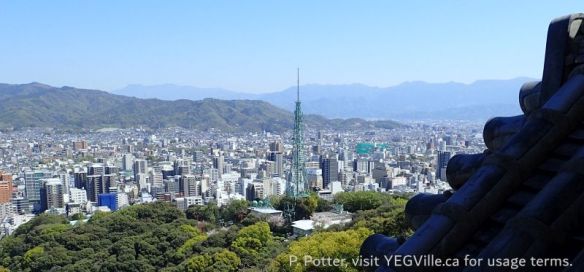
View from the top floor, 2026-04-08, Matsuyama Castle, P. Potter. 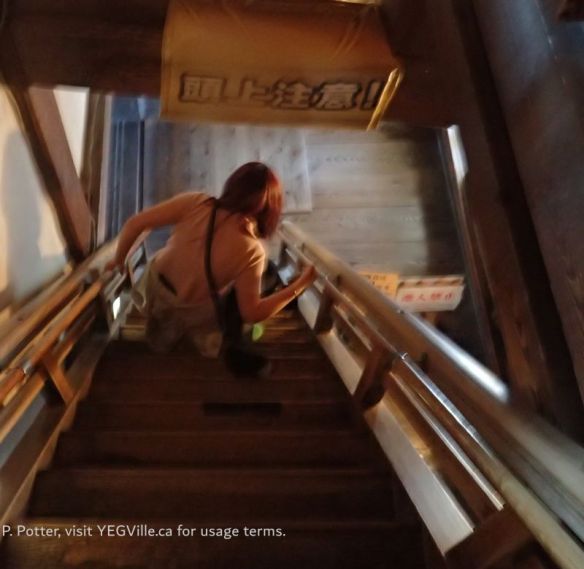
A steeply inclined stairway leading from the top floor, 2026-04-08, Matsuyama Castle, P. Potter. 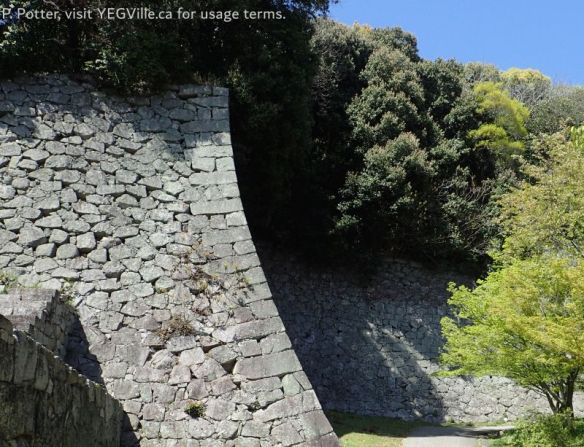
The well-crafted stonework of the outer walls, 2026-04-08, Matsuyama Castle, P. Potter. 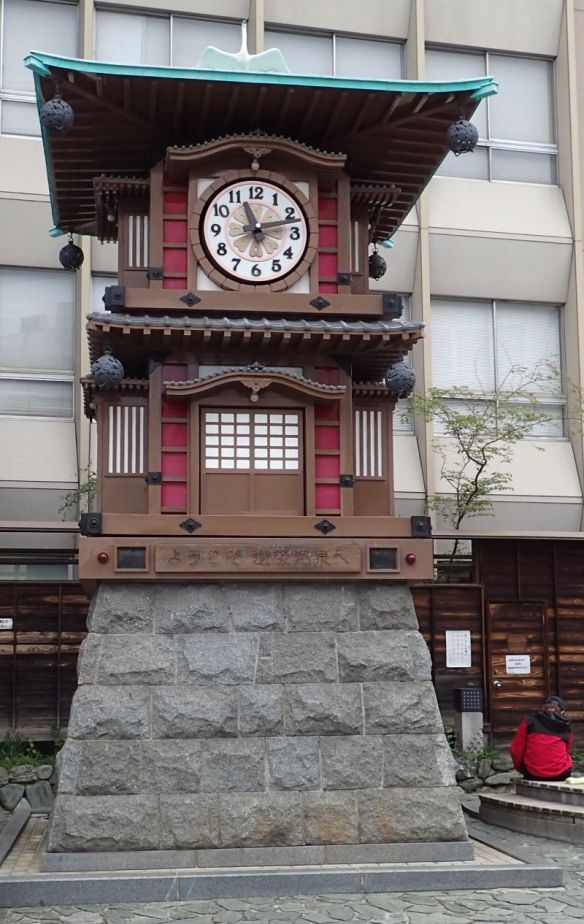
Botchan Karkuri Clock next to the Dogo Onsen Honkan (hot spring), it rises up, plays music and displays characters from the novel, Botchan, 2026-04-09, Matsuyama and area, P. Potter. 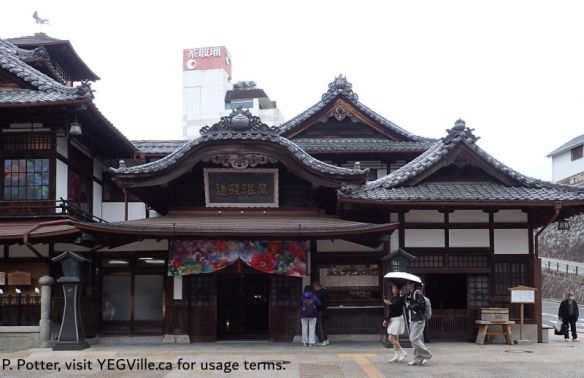
The Dogo Onsen Honkan, 2026-04-09, Matsuyama and area, P. Potter. 
Botchan Karkuri Clock next to the Dogo Onsen Honkan (hot spring), it rises up, plays music and displays characters from the novel, Botchan, 2026-04-09, Matsuyama and area, P. Potter. 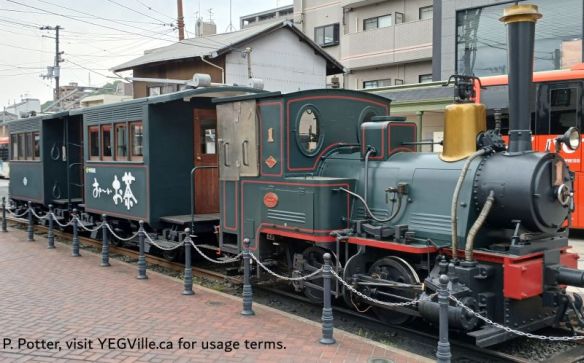
A restored, functioning, and protected ‘Botchan Train’ next to the Dogo Onsen Honkan (hot spring), 2026-04-09, Matsuyama and area, P. Potter.
A Walkable City
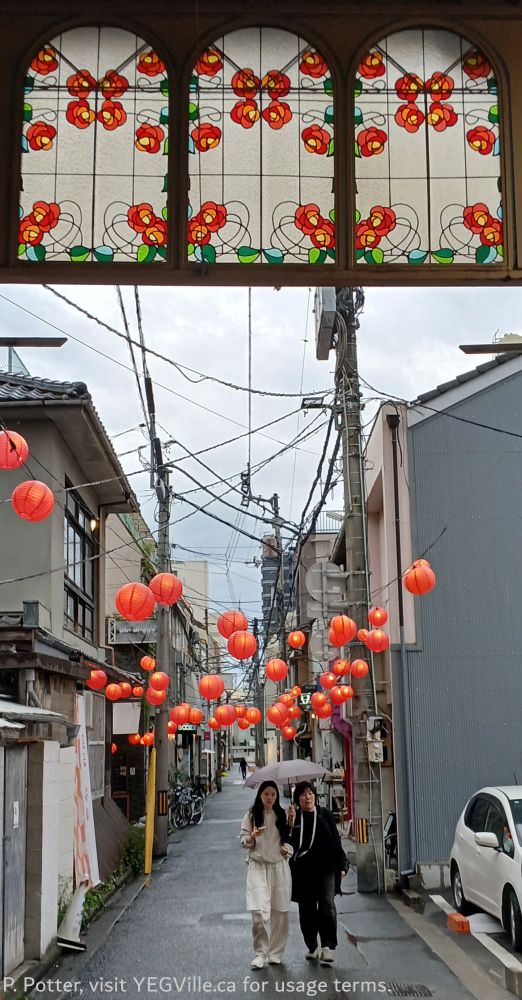
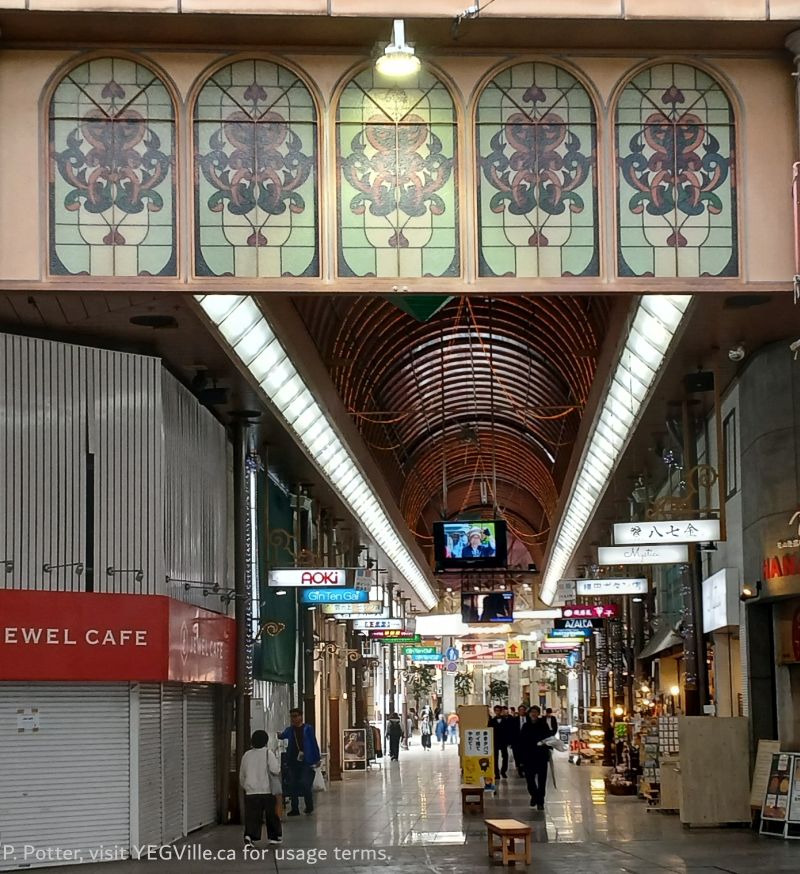
For a tourist, the most important feature of Matsuyama is its walkability. The hotel we were staying at was close to a large galleria or covered shopping street. The famous hot spring, castle, and shrines were all within 2-3 km of our stay. An efficient tram and bus system makes longer distances easy to accomplish. Beyond the city are some outlying islands that beckon for visits with friendly locals as evidenced by my services being called upon.

You’re Having a Bad Day When…
As noted in my initial blog on my Japan visit, Getting to Japan on a Suggestion, my primary role was to solve a logistical problem – how to get the luggage for 15 cyclists from one hotel to another? A secondary role was to be the deep insurance policy for the riders. This was described as me not being sag-wagon but instead the person you call when you are having a REALLY bad day.

Lara was having such a bad day when her chain decamped from her bike. Despite the efforts of numerous elderly by standers, the fix was not to be, and a rescue was needed given the distance. A local lady kindly drove Lara to the ferry and expressed great concern that Lara would have to be by herself (a stray cat kept her company).
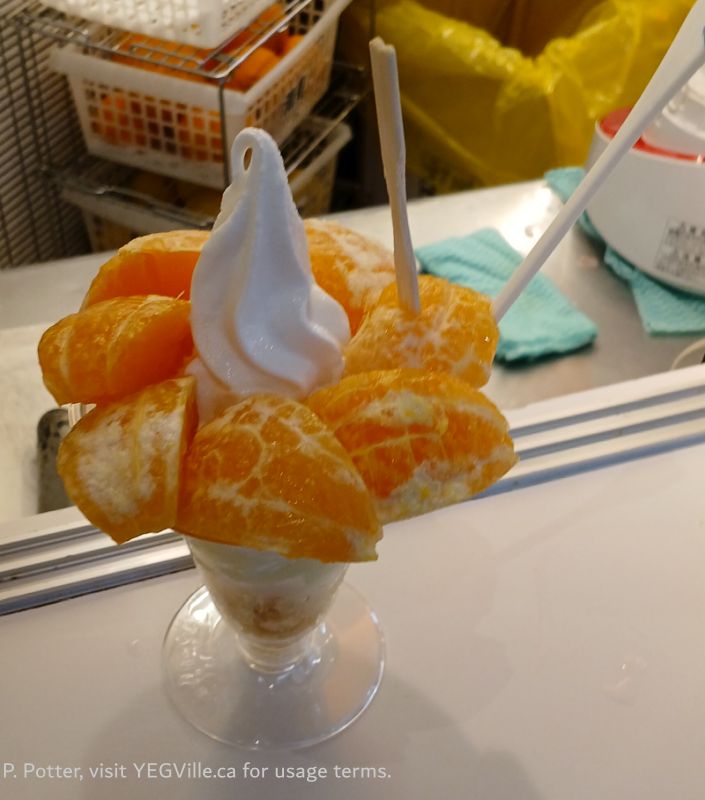
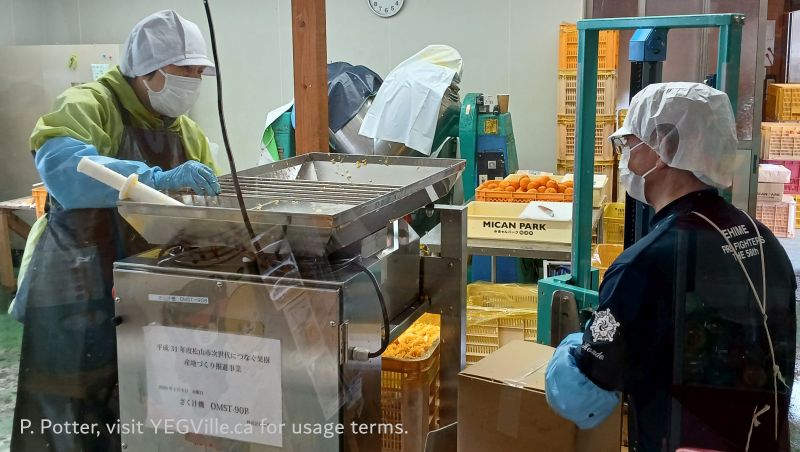
A visit and a huge thank you to the Gogoshima locals and Y’s Road Bike Shop who got Lara on the road again. As a bonus, Lara and I stopped at a local citrus shop to pick up an ice cream treat and see the production of marmalade. All in all, still a good day in Matsuyama.
 YEG Ville