
Clyde Fen, a protected natural area in Alberta, is significant for botanists due to its unique plant life, including rare orchids and pitcher plants. Established in 1993, it consists of multiple parcels, with limited trails and challenging access. It is mainly recommended for botanists rather than casual visitors, particularly in summer.

Clyde, like many Alberta towns, was named for the first postmaster in 1906 [1] and was stop on the Edmonton and Slave Lake Railway [2] on its way north. The protected area, Clyde Fen, was established in 1993 [3] and is spread across three parcels, two of which join diagonally and the third is non-contiguous.

Thank You ANPC. The South and mid parcels contain the fen and wet areas that send botanists swooning. Rare pitcher plans (which eat bugs), orchids, and other green things are found only here (or pretty much only here) [4]. The Alberta Native Plant Council has been the Volunteer Steward for this site since its inception. If visiting the fen in the summer, take great care entering the area as some of these plants are extremely rare and delicate.
What Exactly is a Fen? A fen, you know that marshy, boggy, wet thing… umm, what exactly is a fen? It turns out it is like a bog but is fed from ground water and supports more plant life. All wetlands act like giant filters trapping bad stuff from getting into the water table [5].
Why Go to Clyde Fen? If you are a botanist then plan to visit Clyde Fen but do with the ANPC. They run a May Plant Count and other trips out to the site.
Why Not Go to Clyde Fen? Green stuff notwithstanding, Clyde Fen is one of the natural areas that we are lucky to have but most of us non-plant people should not bother. There are very few trails (yeah!), lots of water, and flying things that bite you in the summer. This explains the relatively low worth it rating… unless you like plants and can tolerate mosquitoes.
Any maps and map views are for general information only. Do not rely on them for navigation or to determine legal boundaries.
The Fast Facts
- Winter Challenge Category: NOT MUCH HERE.
- Not Worth Visiting – except for botanists, birders, etc.
- No Washrooms.
- Not Kid Focused
Area Details
- Name/Owner: Protected Notation Natural Area.
- Is it Worth It and Why Go Here?:
- North Parcel, 2/5: Nirvana for boreal forest botanists, thick and impenetrable woodland for us mere mortals.
- South Parcel, 2/5: It is possible to reasonably snowshoe (or walk on very wet terrain) from TWP 602 to the NW boundary. From there, it is either bushwhacking through fen/forest or retracing your steps. It is possible exit through the abandoned gravel pit to the SE noting that this is private land.
- Wayne Gretzky Units: 70 KM
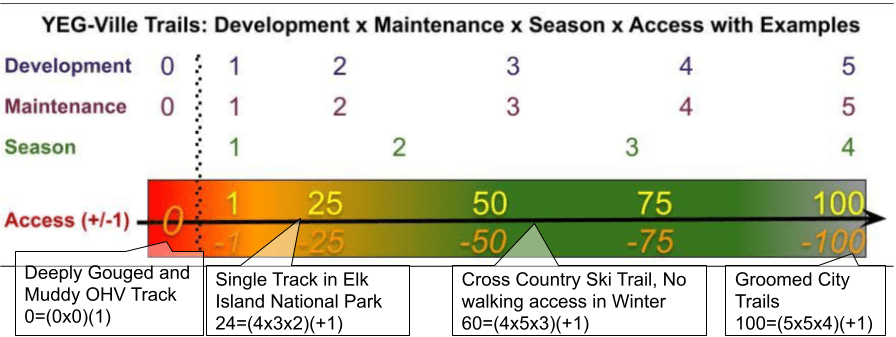
- Trail Classification:
- North Parcel, Rating: 0; Access: Granted; Develop: No trail; Maint: No Human Interventions. ; Season: Single Season: A cut line will take you to the south boundary but no obvious ingresses into the NA proper. The cut line is on private property, but you can ‘probably’ follow the power lines without trespassing.
- South Parcel, 2/5:Rating: 6; Access: Granted; Develop: Limited Development. ; Maint: In Disrepair or Abused; Season: Single Season: Unless you are here for the plants, winter is the best time and after a good freeze. Very wet otherwise.
- The Drive Out: Lots of interesting towns and sites North of St. Albert. This is a transition area between the prairie, boreal forest, sand dunes and other Alberta geography.
- The Other Shoe: Not much to do from a self-propelled perspective. Very pristine (e.g. non-accessible) natural area.
- Frank’s Trip Notes
- First done: 2025-01-07. Weather: Initially cold but then warming up during the day, clear skies and little wind. Comments: Went with David F. who is writing a book on orchids and thus has a keen botanical eye.
(On smart phones, swipe to advance the pictures)

Looking East along the cut line to the south of the NA, 2025-01-07, Clyde Fen PNT – North, P. Pottter. 
Looking South towards the TWP from the boundary of the NA, 2025-01-07, Clyde Fen PNT – North, P. Potter. 
Delicate hoar frost growing on a plant, 2025-01-07, Clyde Fen PNT – North, P. Potter. 
Looking North into the old mine road in the NA, 2025-01-07, Clyde Fen PNT – South, P. Potter. 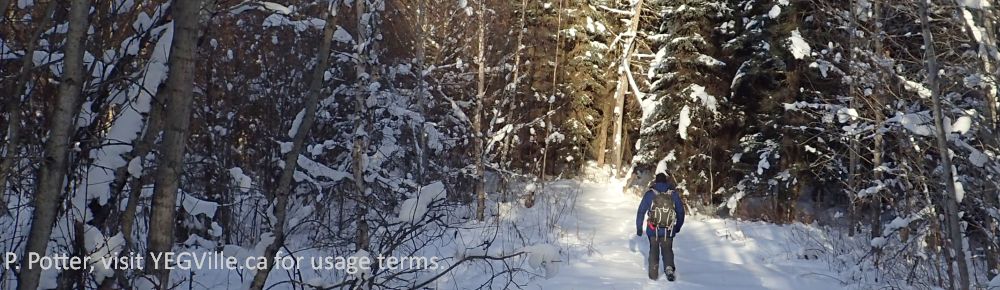
Hiker heading north along the old mine road into the parcel, 2025-01-07, Clyde Fen NA, P. Potter 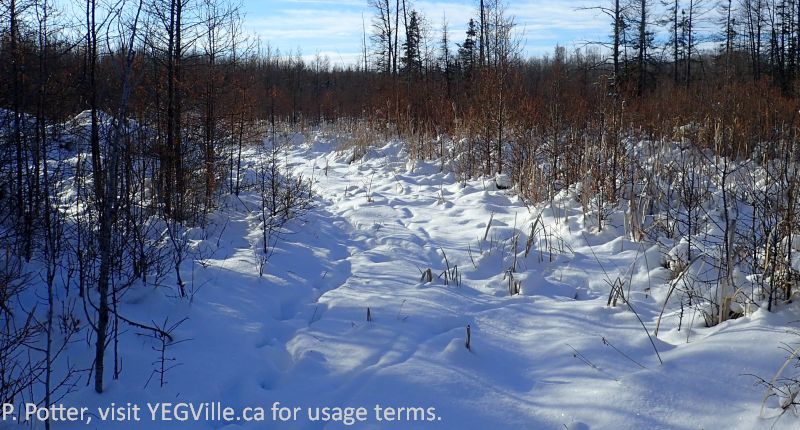
Looking roughly SE into the fen area of parcel, 2025-01-07, Clyde Fen NA, P. Potter 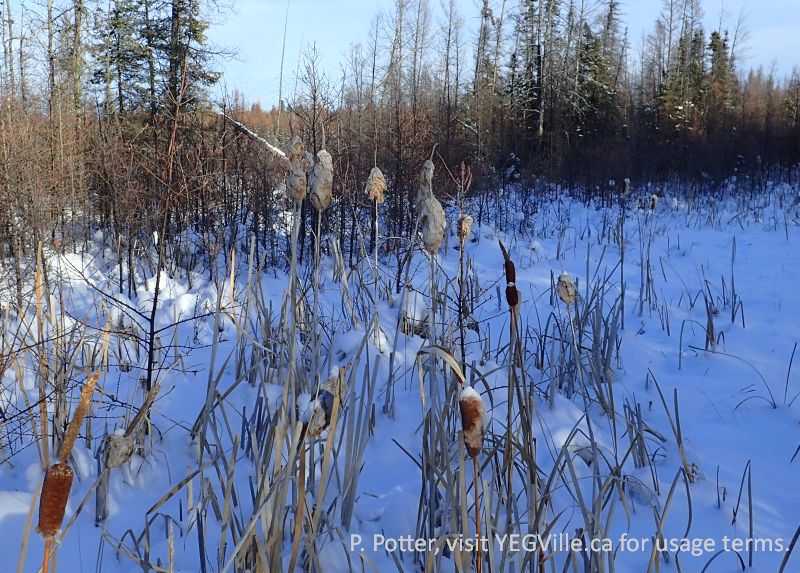
Upright bull rushes suggested limited ATV traffic on the old mine road, 2025-01-07, Clyde Fen NA, P. Potter 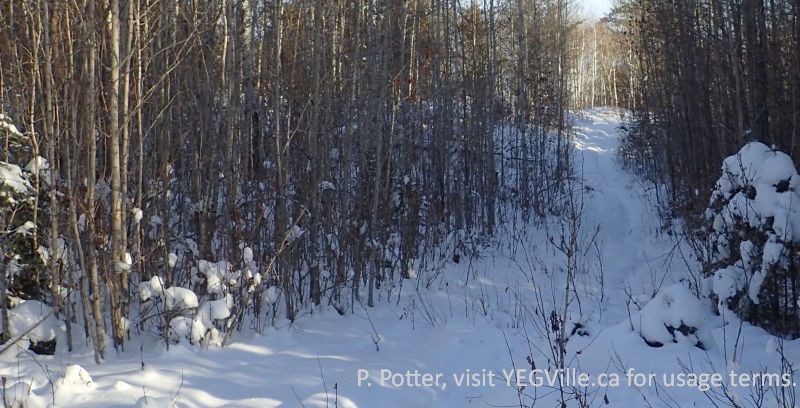
Looking East up a small rise, OHV traffic coming in from the old gravel pit, 2025-01-07, Clyde Fen NA, P. Potter 
Looking North into the adjacent gravel pit, likely common tansy (Tanacetum vulgare), an invasive species,2025-01-07, Clyde Fen South, P. Potter.
Notes and Reference
- DONOVAN, LARRY. ALBERTA PLACE NAMES: The Fascinating People & Stories behind the Naming of Alberta. Canada: DRAGON HILL PUB, 2007, p. 75.
- The Edmonton and Slave Lake Railway was chartered in 1899 to reach Slave Lake via Athabasca Landing. It was acquired by the Canadian Northern Railway in 1902 and construction on the line commenced in 1909, reaching Athabasca in early 1912. (Source: HERMIS: Canadian Northern Railway Station)
- The CNR was never a financial success, was essentially a Crown entity by 1917 and consolidated into the Canadian National Railway in the 1920’s. (Source: Canadian Northern Railway | Wikipedia)
- This is based on the metadata contained within the 2021 edition of the Parks and Protected Areas of Alberta GIS information. Interestingly, the February 2024 version has dropped the PNT and CNT sites.
- Clyde Fen Natural Area | Alberta Native Plant Council.
- Alberta Wetland Classification System. Edmonton, Alberta: Alberta Environment and Sustainable Resource Development, 2015, p. 18.
- Fens are minerogenous peatlands, meaning they receive water from a variety of sources that accumulates dissolved minerals and increases the alkalinity of the environment. Fens are permanently saturated wetlands that have fresh to slightly brackish water and like bogs, are low in salinity and available nutrients. Many vascular plants commonly found in fens are not typically found in bogs.
- Select further reading:
- Focus on Wetlands. Edmonton: Alberta Environment, 2003.
- What is a Wetland? | Wetlands Alberta.
- Canadian Wetland Classification System | Alberta Wetland Policy
Usage: This site is intended for my personal use only and very select invited guests. My recommendation is for you to stay in bed with the covers pulled firmly over your head.
 YEG Ville