What is a site or a trail like? A reasonable question with a perfectly reasonable answer of: it depends. There are four factors to consider: the trail’s development, maintenance, the season, and is the trail legit? An overall factor is whether I would go back or not.
- Classifications as Far as the Eye Can See
- Is the Site Worth Re-Visiting?
- Trail Difficulty Rating
- Power to the Feet!
- Scale of 1 to 100: Development, Maintenance, Season, and Permission
- 0, 1 to 5: How Developed is the Trail
- 1-5 Development Scale
- 0, 1 to 5: Maintaining What You Got
- 1 to 4: Seasons
- -1 or +1: Can We Be Here?
- Putting it All Together
- Notes and References
While YEG-Ville is for ME!, describing trails is a common enough problem that this page can be applied to non-YEG-Ville adventure. But what is the trail like? The Alberta Government’s definition is [1]:
A defined type of infrastructure that is purposefully designed and used for one or more recreation activities. To be a recognized trail, it must be approved by the landowner, mapped, marked and actively managed and maintained.
Trail Development Guidelines for Alberta’s Public Land [1]
Classifications as Far as the Eye Can See
The above definition is great, except for say a moose track in a natural area. It is unlikely the woodland creatures will visit a registry agent to conduct a title search to see whose land they want to graze on. While scat is a form of marking, it is hardly a method of active management.
An internet search on alternative definitions and classification methods yielded dozens of results. Some were relevant and many not (see the further reading section). In the end, I am using a mash up of Alberta’s trail classification system [2], a few other systems, and what is practical to YEG-Ville – but first, would I ever go back?
Is the Site Worth Re-Visiting?
Driving hours to discover that the site is swampy, inaccessible due to private land, or just not that much fun yields the Return Visit Rating. The scoring is a function of not only what is in the site but also how far away it is from Wayne Gretzky.
| Visit | Rating | Description |
| 1 | Don’t Bother | Not worth going back to for reasons explained in the comments. |
| 2 | Mehh | Likely will never go back but never say never |
| 3 | Bubble | On the bubble about going back, maybe if in the neighbourhood |
| 4 | Probably | Probably will go back… unless another adventure trumps! |
| 5 | Definitely | Worth many repeat visits. |
Trail Difficulty Rating
The following was created to assess snowshoeing but works surprisingly well for hiking. An Easy-Peasy snowshoe is typically the same in the summer. The reason for this scale is to decide if a site is worth the drive. I have been to them all and some live up to their advanced billing, some are little known jewels and others are, well stinkers.
As well, the stink-i-ness of a location is in the snowshoe of the beholder. For a beginner, a few KMs of trail and a washroom if shoe-Nirvana. For an experienced individual, that Nirvana is boring.
As a result, all of the locations are grouped into the following three Challenge-categories:
- EASY-PEASY: While short on distance or technical challenges, these locations offer washrooms, trails and a place for Low Beginners+ to try out the sport. They are typically kid-friendly meaning there is a playground or something to keep a 4-16 year old occupied. EASY-PEASIES are good for other activities such as cross-country skiing, walking, taking Fido for a stretch, or fat biking.
- ADVENTURE: A step up form Easy-Peasy, these locations either offer longer distances (e.g. 5+ KM), involve ice safety (e.g. a frozen lake or river) or have some technical challenges. They may have washrooms and other amenities but don’t count on it. If your kids are more adventurous, bring them along. Activities beyond those with done in EASY-PEASY locals may include ice fishing or hunting. These locations are for Beginners and above.
- OFF THE BEATEN TRACK: These are other locations in natural areas and land trusts in and around the city. There are hundreds of these locations many coming with interesting stories of early settlers, First Nations, or a generous land owner who has made a donation. Not all of them have been well cared for, however, All Terrain Vehicles (ATVs) gouge deep ruts or there are few trails to follow. Nevertheless, they are included as part of the legacy of nature available to us YEG-Villers. Some are worth the drive. For others, drop by only if you are in the neighbourhood.
- NOT MUCH HERE: Sometimes things don’t work out. I am listing these locations even if I really never need to go back (at least for snowshoeing). You may still want to drop by but don’t say I didn’t warn you.
Power to the Feet!
This system focuses on foot-based activities (e.g. walking, hiking, snowshoeing, skiing, etc.). This is as opposed to mechanized (e.g. cycling), motorized (e.g. off-highway vehicles), water tracking (e.g. canoeing), or animal assisted (e.g. horse trail riding). Some of these can be applied to the following system (e.g. cycling) while others are ignored (e.g. water, animal, or motorized).
Scale of 1 to 100: Development, Maintenance, Season, and Permission
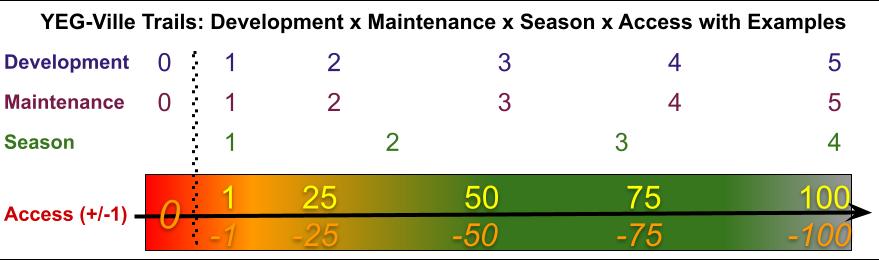
I am using four variables to describe the trails on this site. The first two have a rating scale of 1 to 5 and the season variable has a scale of 1 to 4. The three variables are multiplied together to get an overall rating between 1 and 100. A rating of 1 means the trail is non-existent (an animal track) and only passable during a single season (e.g. winter). A rating of 100 is an urban park setting with asphalt, winter snow clearance, garbage cans.
The permission rating is a yes/no affair. +1 the landowner is cool with you being there; -1 permission is not granted.
0, 1 to 5: How Developed is the Trail
Humans like trails. Jump back in time to pre-European contact First Nations used foot-based highways to find their next meal or trade with other groups. Trail development was a function of being the ‘path’ of least resistance, heading the right direction, and well-worn enough.
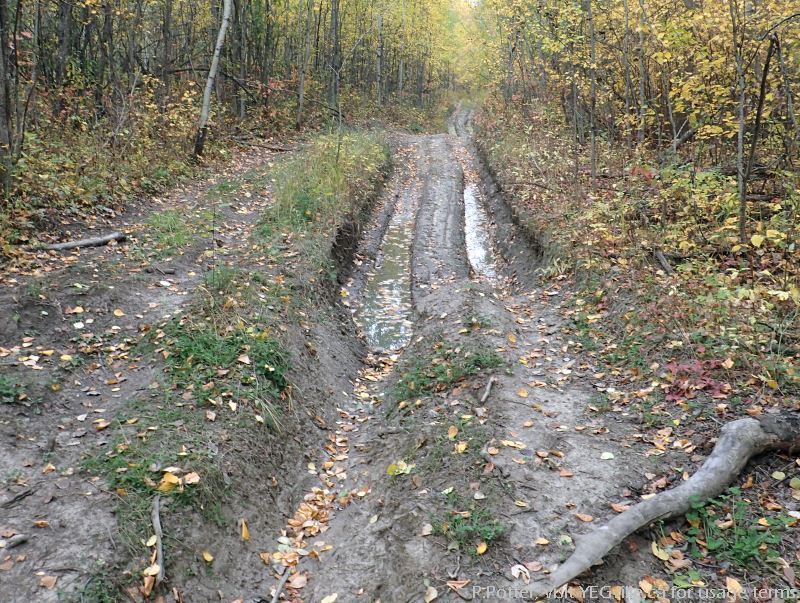
- 0-Rating: No trails worthy of that name, for example deeply rutted ATV tracks which is impassable or at least not enjoyable to walk on.
1-5 Development Scale
Value of 1 is undeveloped, 5 of the asphalt variety. Although the following tries to provide precision, there is an element of subjectivity in assigning a rating.
- Non-Human or Passable-Human. Animal Tracks with no human traffic using the trails. Examples: a moose track even if followed a few times by an erstwhile hiker or hopeful hunter. ATV tracks that have not yet gotten to the point of destruction and impassibility. A cut line or utility corridor would also fall into this category as they have a habit of traversing marshes or deep valleys.
- Traditional Trail. A single-track used enough by humans for the trail to be easily and obviously navigated as route. No defined signage, bridges or infrastructure. Examples: sidetracks in Edmonton’s River Valley; used frequently but not an official trail; or
- Low Usage ATV Track. As destructive as ATV’s are, they do make nice trails… until they are over used. Thus a low usage ATV track might have its place, for a period of time anyway.
- Limited Development. A middle zone between an ad hoc way to get from A to B and a defined trail. Some developments such as a crude bridge thrown up over a water course or survey tape on trees. Examples: often ATV’s will do some remediation so as not to get stuck in the muddy holes they have created.
- Earthen Track. Earthen tracks such as ski trails with signage and other infrastructure. Not quite a walking-highway but getting close
- Fully Developed. Some or most of the trail surface is all season, covered by compressed gravel, asphalt, or concrete. Bridges abound. Signage on routes are/were in place.
0, 1 to 5: Maintaining What You Got
This measure is dependent on the above development measure. Moose are notorious for not wanting to join trail-maintenance work crews. Non-human tracks automatically have no maintenance. Cities do a good job of keeping their walking trails in good shape for the enjoyment of citizens and avoiding liability. In between lie tracks maintained by volunteers or cash strapped governments.
- 0-Abuse: No pre-existing infrastructure and/or abuse such as ATV rutted trail.
- No Human Interventions. Naturally being maintained by the occasional passing moose.
- Little used, In Disrepair or Abused. Loss of infrastructure due to neglect, vandalism, etc. Ad hoc work arounds for significant deficiencies. Cautions may be needed due to risks associated with walking based activities. Examples: trails created by a now defunct volunteer association.
- Low Usage ATV Track. As destructive as ATV’s are, they do make nice trails… until they are over used. Thus a low usage ATV track might have its place, for a period of time anyway.
- In Progress. Repairs or initial construction is in progress but not completed. These repairs may be official or ad hoc.
- Serviceable. In need of some repairs but generally usable. No significant areas of risk. Examples: a few missing signs, some overgrowth.
- Maintained. New or consistently maintained.
1 to 4: Seasons
Can the trail be reasonably used year-round? Some trails are easier to navigate in the winter when the ground water is frozen. A dry fall may also do the trick. Anything less than a year-round rating warrants a comment.
- Single Season. Only accessible for a few weeks of the year. A frozen creek hike.
- Two Seasons. Accessible for longer than a few weeks but less than about six months. A trail best accessed in the Fall and Winter.
- Three Seasons. Not accessible a few weeks of the year, e.g. during the spring melt.
- All Season. Accessible year round.
- Comments: Notes for anything less than All Season.
-1 or +1: Can We Be Here?
As noted in YEG-Ville & Land Ownership, 60% of Alberta is public or Crown Land. Most foot-based traffic on Crown Land is cool. Illegal access may have occurred, for example, ATVs in a Natural Area. This rating has only two settings: +/-: has the landowner (including the Government of Alberta) given permission for the creation of the trail you see in front of you? This rating applies not only to the trail but also to the trail head.
- 1: Permission is granted by the Landowner.
- 0: Permission is not granted or right of access is unclear to the trail or trail access.
Putting it All Together
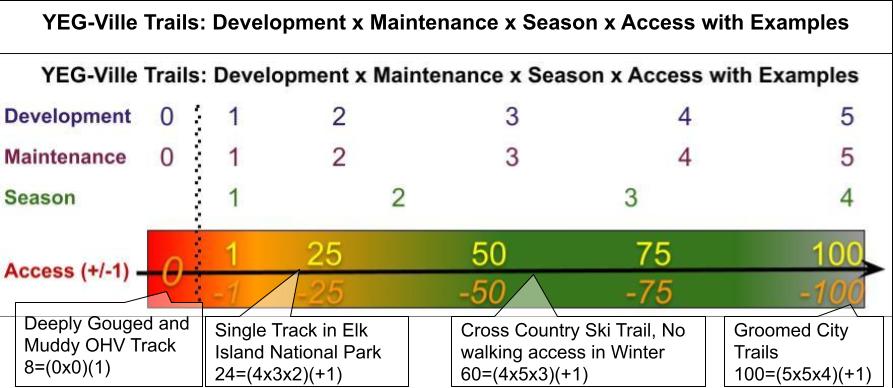
5 X 5 X 4 X 1 = 100 combinations of trail conditions. The following graphic shows these combinations although not all of the 100 combinations are possible. The green shading shows YEG-Ville preferences. Asphalt trails are good in a pinch but single track in nature is even better.
Notes and References
- “Trail Development Guidelines for Alberta’s Public Land – Open Government.” Accessed September 2, 2023. https://open.alberta.ca/publications/9781460145609.
- “Alberta Recreation Corridor & Trails Classification System – Open Government.” Accessed September 2, 2023. https://open.alberta.ca/publications/9780778557319.
 YEG Ville